The Five-Pence Failure: Fixings That Actually Survive a British Garden
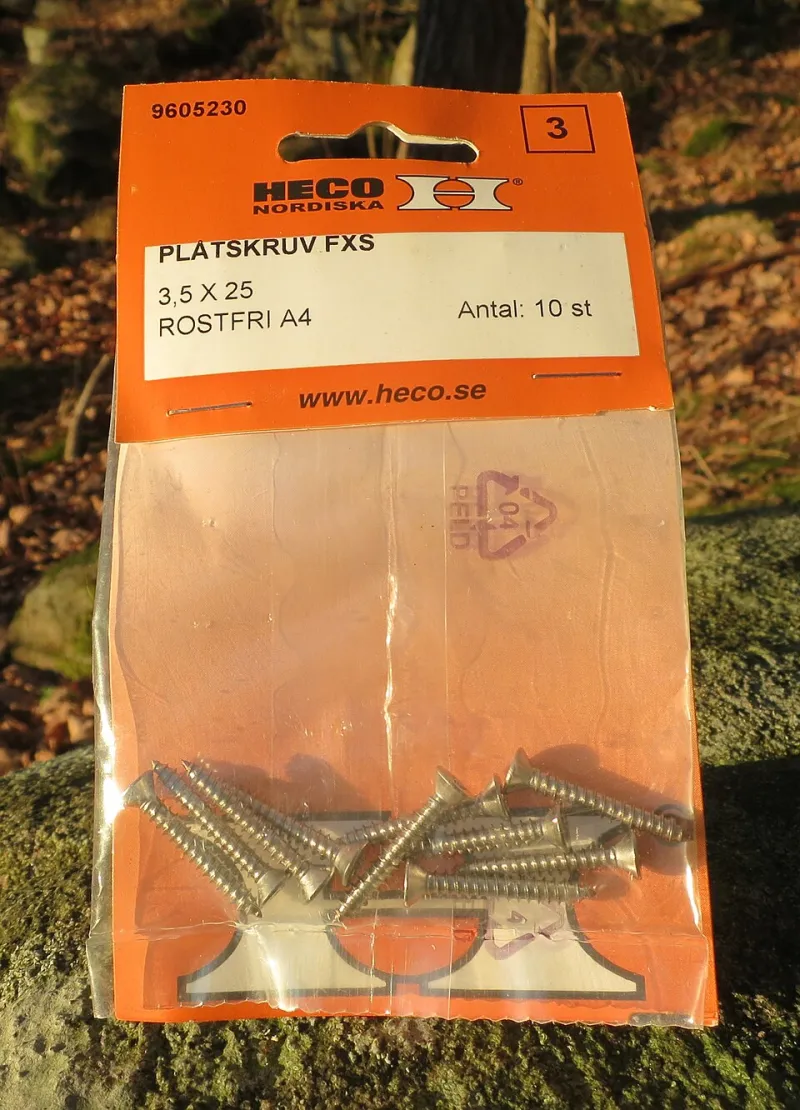
Photo: R. Henrik Nilsson, CC BY 4.0, via Wikimedia Commons
Most garden timber failures start with a five-pence fixing. The post is sound; the bracket has gone. The deck board is fine; the screw has snapped. The oak gate looks lovely; a line of blue-black stains runs down from every hinge. We spend weeks choosing the timber, then grab the cheapest box of screws from the till end and expect it to last a decade. It won't.
Fixings are the weak link because they are small, cheap and usually hidden. They also sit in exactly the places that stay wet longest: the bottom of a post, the top of a joist, the hole in a bracket where water pools. In a British garden, that is a hard life. Cold, wet, occasional salt, wind loading and a lot of wood that stays damp for months.
This is a practical field guide, not a chemistry lesson. The aim is simple: choose fixings that match the exposure, the timber and the job — and stop paying twice.
Start With the Weather, Not the Box
The UK does not have one garden climate. A sheltered London courtyard is not the same as a Pembrokeshire cliff or an exposed Peak District garden. Before you read the label, decide which conditions apply:
- General damp: most inland gardens. Wet winters, humid summers, timber that dries slowly.
- Coastal: salt spray and onshore wind. Salt accelerates corrosion and attacks lower-grade stainless.
- Exposed: upland, fenland or windy sites. More movement, more uplift, more water driven into joints.
- Sheltered but shady: courtyards and north-facing gardens. Less drying, more mould and staining.
- Oak and other tannin-rich timbers: green oak, sweet chestnut and some cedars. These react with iron and can stain.
A fixing that is fine in a sheltered porch may fail in a coastal pergola. That is not a manufacturing fault; it is a specification mistake.
Stainless, Galvanised, Coated: A Plain-English Ranking
You will see three broad families on sale. They are not interchangeable.
Stainless steel is the safest default for visible exterior work and for oak. A2 (304) stainless is fine for most inland garden jobs. A4 (316) is the better choice within a few miles of the coast, around salt water, and where you are fixing oak or pressure-treated timber that stays wet. Stainless is not magic — it can stain timber if swarf is left behind, and lower grades can spot in aggressive coastal air — but it is the most predictable option.
Hot-dip galvanised fixings and brackets have a thick zinc coating. They are excellent for structural brackets, post bases and hidden connections in general garden use, provided the coating is thick enough and not damaged. Look for a proper hot-dip standard rather than a vague “galvanised” claim. Thin electroplated zinc, often sold as BZP, is really an interior or sheltered-use fixing. It will not last in a wet post base.
Coated fixings — painted heads, organic coatings, “anti-rust” finishes — can be useful, but the coating is only a skin. It chips when you drive the screw, and it rarely survives a spanner or a socket. A coated screw is not automatically an exterior screw. If the coating is the only protection, treat it as a sheltered-use fixing.
The Quiet Damage: Galvanic Corrosion and Staining
Two different metals, water and oxygen make a small battery. The less noble metal corrodes faster. That is galvanic corrosion, and it is why a stainless screw in a cheap aluminium bracket can turn the bracket to white powder, and why a galvanised bracket can suffer around stainless fixings in a wet, salty joint.
The practical rules are simple. Keep dissimilar metals apart where water sits. Use isolating washers or plastic separators where a stainless fixing passes through a galvanised or aluminium component. Do not mix whatever is in the odds tin. And if a joint stays wet — a post base, a deck ledger, a pergola shoe — spend the money there first.
Oak is its own case. Tannins in oak react with iron and steel, leaving blue-black stains that sanding will not always remove. Use stainless fixings in oak, and be careful with galvanised brackets: they can still stain in wet conditions. If you are building with green oak, accept that the fixing choice is part of the design, not an afterthought.
Pressure-treated timber is less dramatic but not innocent. Modern treatments often contain copper. Copper and aluminium are a bad pairing in damp conditions, and cut ends of treated timber can be more corrosive than the surface. Use stainless or well-coated hot-dip fixings around treated timber that will stay wet, and reseal cut ends.
Four Rules by Build
Posts. The bottom of a post is the hardest working part of any garden structure. Do not bury a post in concrete and hope. Use a post base or shoe that keeps the timber above standing water, and fix it with stainless or hot-dip galvanised hardware. If the base has a pocket that holds water, drill a drain hole or choose another design. A post that rots at the base is usually a fixing and drainage failure, not a timber failure.
Rails and gates. These move. Use bolts with washers rather than screws where the load is structural, and allow a little movement in the joint. Over-tightening a stainless bolt into soft timber crushes the grain and creates a water trap. A slotted or oversized hole in a metal strap can save a gate from splitting in a gale.
Pergolas. Wind uplift is the thing nobody thinks about until a beam lifts. Use proper connectors, through-bolts and plates rather than a handful of long screws. In oak, use stainless throughout. In treated softwood, hot-dip galvanised brackets are usually fine, but check that water can leave the joint. A pergola that stays damp at every connection will not age gracefully.
Decking. Deck boards fail at the fixing line. Use stainless or a reputable coated decking screw with a small head and a shank that clears the board. Do not use drywall screws, and do not use short screws that only bite into the top of a joist. In coastal gardens, go stainless. Leave the recommended gap, and check the joists and hangers as often as the boards.
Buying Honestly
Ignore “rust proof”. It means nothing in a garden. Look for the grade, the standard and the coating thickness. Buy from a merchant who can tell you what the fixing is made of. Buy a few spares and keep them dry. And when you replace a fixing, replace it with the same or better material — not whatever is nearest.
The timber gets the credit and the blame. The fixing does the work. Spend a little more on the five-pence part, and the expensive part will last.