A Shed Should Breathe: Why Your Garden Building Isn't a Tiny House
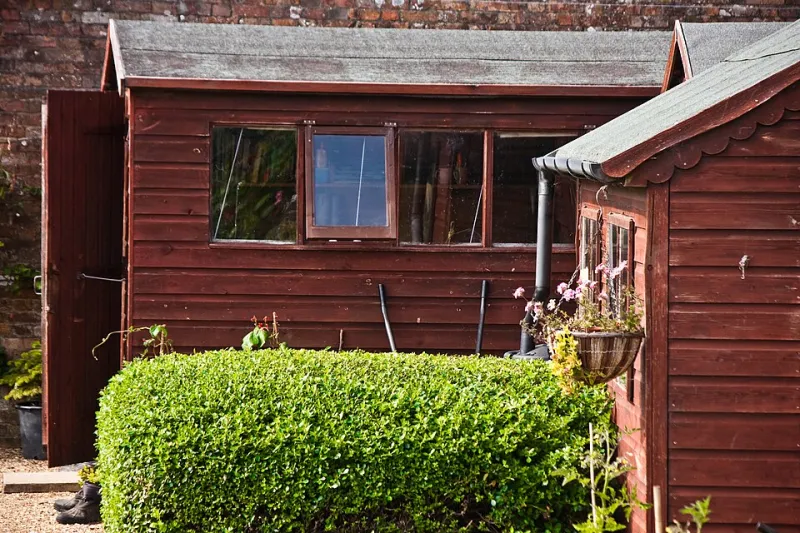
Photo: Garry Knight from London, England, CC BY 2.0, via Wikimedia Commons
There is a particular smell to a garden shed in November. Cold metal, damp hessian, and something faintly organic coming from the corner where the potting compost lives. It is the smell of a small building quietly failing at its one job.
And it fails, more often than not, because we've asked it to do the wrong job entirely.
The tiny house temptation
Somewhere in the last decade the garden shed stopped being a shed. It became a studio, an office, a gym, a 'retreat'. Search for shed inspiration and you'll find timber buildings lined with ply, packed with insulation, sealed with a vapour barrier, fitted with a little stove and photographed at golden hour with a blanket over a chair.
None of that is wrong in itself — a properly heated, properly built garden room is a fine thing. But it is a different building from the one most of us actually own. And a shed that has been half-converted, sealed up without being properly heated, is worse than a plain one. It's the worst of both worlds: no ventilation, no warmth, and every scrap of moisture trapped inside with your chisels.
Condensation is arithmetic, not bad luck
Warm air holds water. Cool it down and the water has to go somewhere. In a sealed shed, the cool surfaces are the tools, the window, the underside of the roof, the concrete slab. That's where the droplets form — on steel first, then on anything else that's colder than the dew point.
The arithmetic rarely changes because of what you add. Insulating a building you don't heat makes the inside slightly colder on the whole, pushes the dew point onto tools and stored timber, and shuts the door on the draught that used to carry the moisture away. You've made a flask. A cold, damp flask.
Where the water comes from
It's worth being blunt about this, because most people assume the leak is the roof. Usually it isn't. Water in a shed comes from: a slab or soil beneath an unraised floor; wet tools, boots and garden kit carried in after rain; a damp mower, a wet sack of compost, a hose reel; timber that was brought indoors still green or soaked; your own breath over an hour of pottering; and, in a lot of gardens, a leaking gutter or a downpipe discharging quietly against the back wall.
Solve those and most sheds dry out on their own. Ignore them and no amount of insulation will help.
Ventilation beats insulation
A shed is, functionally, a weatherproof box with a very low occupancy. It doesn't need to be warm. It needs to be dry. Those are not the same aim, and the second one is far cheaper to achieve.
Practically that means: high-level vents at both gables so there's a through path for air; a gap under the eaves; a floor built up on bearers so air moves beneath it; and a door that fits well enough to keep rain out without sealing like a fridge. If the shed has a felt or membrane roof, check for a vented path above the insulation, or no path at all.
A cold shed with moving air will keep a saw blade in better condition than a warm sealed one. This is not a controversial claim — it's just not what the images online tend to show.
Get the floor off the ground
If you take one thing from this piece, take this. A timber floor laid straight onto a slab is a wick. Water migrates up through the boards, the bottom of every stored item sits in the damp, and by February the whole building smells of it.
Raised bearers of 100mm, running the short way with gaps at each end for air to pass, will do more for your shed than any wall insulation sold to you. Where the shed sits on a concrete base, add a damp-proof course and keep the cladding 25mm clear of the ground so water can't splash up into the bottom rail.
Wet side, dry side
Most sheds are asked to store both a mower and a sharp chisel, and the two live in a state of undeclared war. The fix is separation rather than heroics. A covered lean-to along one side, or a simple open rack just outside the door, takes the spades, the hose, the boots and the compost. Inside stays for timber, tools, seed and anything that rusts.
Where there's no space outside, a drip tray under the mower and a lidded plastic box for wet gloves is a decent compromise. But a shed that holds damp gardening kit at close quarters with steel is a shed that will cost you a set of tools every few years.
Materials that forgive being wrong
On the outside, feather edge or tongue-and-groove cladding with a breather membrane behind it handles British weather well, because it can dry to both faces. What it can't handle is being sealed with impermeable paint on the inside and outside at once, which traps any driven rain that gets past the surface.
Avoid OSB in any position where it can get damp — it has its uses, but a shed interior isn't one of them. Use stainless or galvanised fixings so rust streaks don't become structural. And leave the internal lining off unless you're going the whole way with a proper warm build, because a ply lining screwed over battens with no ventilation path is a mould farm with a nice finish.
When insulation is genuinely right
If you use the building daily, heat it through the winter, and are prepared to do it properly — continuous insulation, sealed vapour barrier on the warm side, controlled ventilation — then insulate away. The mistake is the halfway house: a bit of rockwool between battens, a plug-in oil radiator on frost setting, and no barrier anywhere. That arrangement gives you a warmer surface for condensation to form on and a higher moisture load from the heater's own combustion-free but still humidifying effect on the air.
If you only want to stop things freezing, consider whether they need to be in the shed at all. Some things simply don't mind the cold — they mind the wet.
The February test
Buy a cheap hygrometer and leave it in there. If relative humidity is sitting in the eighties or nineties on a still morning, you have a ventilation problem, not an insulation one. Open the doors on dry days, clear the vents, lift the stored timber off the floor, and get the wet kit out from under the same roof as the dry kit.
A good shed isn't a small house. It's a well-ventilated box with a decent floor and a strict door policy. Which is, in the end, exactly what a garden needs.