Build to Your Arms, Not the Timber Rack: The Raised-Bed Width Problem
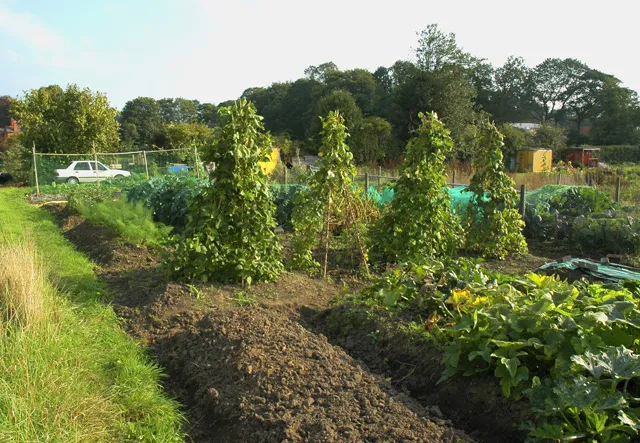
Photo: Gwilym James, CC BY-SA 2.0, via Wikimedia Commons
There is a moment in every raised-bed build when the timber decides the design. You have bought two lengths of 2.4m board, you have a saw, and suddenly the bed is 1.2m wide because that is what halves neatly. It looks fine on the lawn. Then the soil goes in, the plants go in, and by July you are stretching over a metre of wet courgette foliage to reach a tomato that has rolled into the back corner.
That is not a raised bed. That is a small allotment with no gate.
The only measurement that matters is your arm
A raised bed is a working surface. You need to reach the middle without standing in it. For most adults, a comfortable reach from one side is about 60cm. That gives you two sensible widths: 60cm for a bed you can only access from one side, and 1.2m for a bed you can walk around. The 1.2m rule is not a gardening cliché. It is the point at which two 60cm reaches meet in the middle. Any wider and you are climbing, kneeling on boards, or pretending you cannot see the weeds.
If a bed sits against a wall, fence or shed, make it 60cm. Not 90cm. Not 'about a metre'. Sixty. You will thank yourself when you are harvesting in a drizzle and not trying to levitate.
Why garden centre kits get it wrong
Walk into a UK garden centre in 2026 and you will still see raised-bed kits in sizes that look generous and behave badly. A 1.8m-wide kit is common. So is a 2.4m-long bed with no clear thought about which side you can actually stand on. The kit is not evil. It is simply built around palletised timber lengths, cardboard packaging and a photograph of impossibly tidy chard. The width is an accident of supply, not a decision about reach.
There is also the depth problem. Deep beds look impressive and sell well. But a 60cm-deep box that is 1.8m wide is a lot of soil to buy, barrow and keep moist. A 30cm-deep bed is usually plenty for salads, herbs, beans and most veg. If you want deeper soil for carrots or parsnips, make a narrower bed rather than a wider one. Depth is easy to justify. Width has to be earned by access on both sides.
Rot starts at the soil line
Board thickness matters more than most kits admit. Thin decorative boards — the 19mm stuff that looks neat on a pallet — will bow under wet soil and fail at the joints. For a bed up to about 30cm high, 38mm pressure-treated timber is a sensible minimum. Go to 45mm if the bed is deeper, longer or likely to be leaned on. The extra cost is small compared with replacing a bowed frame in three years.
The weak point is almost always the soil line. That is where damp, oxygen and soil bacteria meet timber. Keep the finished soil level 5cm or so below the top board so rain splash and mulch do not sit against the timber. Use timber rated for ground contact, and do not be tempted to bury untreated offcuts as a decorative base. If you line the inside, use a breathable membrane rather than a sealed plastic sheet that traps water against the wood. Good drainage and air movement do more for longevity than any miracle coating.
The real cost is the fill
A raised bed is a box you fill with bought soil. That is the part people underestimate. A bed 2.4m long, 1.2m wide and 30cm deep needs roughly 0.86 cubic metres of growing mix. A bed 1.8m wide and 60cm deep needs more than double that. Bagged compost is sold in litres for a reason: it is expensive by the barrowload. For anything larger than a couple of small beds, price bulk topsoil and compost from a local landscape supplier, and expect to mix in organic matter rather than fill the whole box with premium bagged compost.
Do not fill the bottom with rubble unless you have a genuine drainage problem. Rubble steals soil volume and dries the bed out in summer. Logs and brash at the base can work in a deep bed, but they sink over time and need topping up. The honest approach is to build the bed you can afford to fill properly. A shallow, narrow bed with good soil beats a deep, wide box half-filled with hope.
Three shapes that work
The 60cm fence-run bed. Two 2.4m boards cut to length, set 60cm apart, against a sunny fence or wall. You can reach the whole bed from the path. It is easy to net, easy to crop-rotate in sections and cheap to fill. This is the shape I would build first in most UK gardens.
The 1.2m island bed. A bed 1.2m wide and up to 2.4m long, with a 60cm path all round. You can reach the middle from either side, which means no standing on the soil. It suits a veg patch in a lawn or a pair of beds flanking a path. Keep the paths wide enough for a wheelbarrow; 60cm is a minimum, not a luxury.
The keyhole or U-shaped bed. For a wider space, do not build one big rectangle. Build a U around a central path, or a keyhole bed with a narrow access channel into the middle. The growing area can be wider overall, but no plant is more than 60cm from a standing point. This is the shape that makes a productive garden feel generous without making it unreachable.
If your bed is already too wide
You have options, and none of them require pretending the problem is fine. The cleanest fix is to split the bed: cut the frame down the middle, insert a 60cm path, and turn one wide box into two narrow ones. If the frame is solid and the soil is already in, a keyhole path through the middle is less disruptive. Lift a 60cm strip of soil and set a paved or bark path into it, then edge the sides with offcuts. For a bed against a wall that is too deep, remove the back board and pull the soil back to 60cm; use the spare timber for a compost bay or a cold frame.
If none of that appeals, stop growing sprawling crops in the back half. Put permanent herbs, rhubarb or cut flowers there and keep the reachable zone for things you pick weekly. It is a compromise, but it is a conscious one.
Raised beds are simple structures with a human dimension. Get the width right and everything else — filling, planting, weeding, harvesting — gets easier. Get it wrong and you have built a very tidy obstacle. Measure your reach before you measure the timber rack.